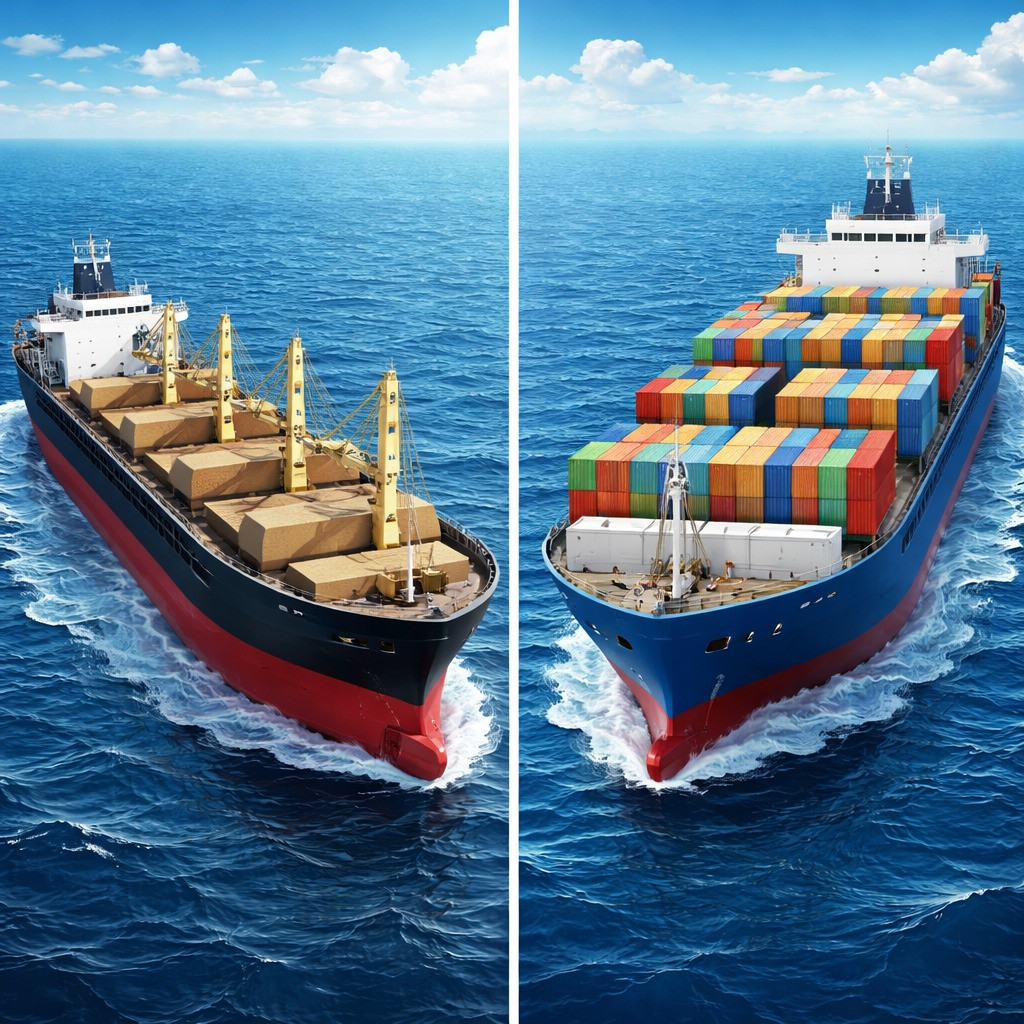
If you spend even a little time around ports or shipping yards, you’ll notice one thing quickly — not all ships are doing the same job. Some are carrying raw materials in huge quantities, while others are moving packed goods across the world.
That’s where bulk carriers and container ships come in.
At first glance, both look massive and similar. But once you understand how they work, you realize they are built for completely different purposes.
Understanding Bulk Carriers in real terms
A bulk carrier is all about volume. It is used to move large quantities of loose cargo — the kind of materials that don’t need packaging.
Think about coal, grain, or iron ore. These are not items you pack in boxes. They are simply loaded directly into the ship.
Inside the ship, there are large cargo holds. These are like giant storage spaces where material is poured in. The design is simple but strong because the cargo is heavy.
Where bulk carriers are used:
Power plants (coal supply)
Steel industry (iron ore)
Agriculture (grain transport)
Construction (cement and minerals)
Bulk carriers may not look complex, but they handle some of the most important materials in the world.
Understanding Container Ships in daily life
Now think about the products you use every day — your phone, clothes, electronics, or even packaged food. Most of these items travel in containers.
A container ship carries these goods inside big metal boxes. Each container is packed, sealed, and labeled before loading.
Once they reach the port, cranes lift these containers and place them on the ship in an organized way.
What makes container shipping special:
Everything is pre-packed
Easy to load and unload
Different goods can travel together
Better tracking and handling
This system is one of the biggest reasons global trade has become so fast and efficient.
The difference — explained simply
Let’s not complicate it.
A bulk carrier carries loose material.
A container ship carries packed goods in boxes.
That one difference changes how everything works.
Loading and unloading — what actually happens
Bulk carriers require heavy equipment. The cargo is poured in using conveyors or cranes. When unloading, similar machines are used.
This process takes time, and after unloading, the ship often needs cleaning before loading a new type of cargo.
Container ships are much more straightforward. Containers are lifted and placed using cranes. Since everything is already packed, there’s no mess and no need for cleaning between cargo types.
Time at port — a big factor
Ports are always busy, and time matters a lot. Container ships are designed to move quickly. They arrive, load or unload containers, and leave within a short time.
Bulk carriers stay longer because handling loose cargo is slower and more complex.
Safety — what really matters at sea
When cargo is loose, like in bulk carriers, it needs to be handled carefully. If it shifts during the journey, it can affect the ship’s balance. Also, some materials can be sensitive to moisture or temperature.
Container ships reduce this risk. Goods are sealed inside containers, which protect them from weather and damage.
Flexibility — which one adapts better
Bulk carriers are limited. They are used for specific types of cargo only. Container ships are flexible. One ship can carry thousands of containers, each with different goods. This is why container shipping is used for global trade on a large scale.
Cost — how businesses decide
Bulk carriers are more cost-effective when transporting large volumes of a single material.
Container shipping costs more, but it offers:
Better safety
Faster handling
More flexibility
So businesses choose based on what they need — not just price.
Size and capacity
Both types of ships can be very large, but their capacity is measured differently.
Bulk carriers are measured in tons (how much weight they can carry).
Container ships are measured in TEU (number of containers they can carry).
Some modern container ships carry over 20,000 containers, while large bulk carriers can carry hundreds of thousands of tons of cargo.
Design difference — why they look different
Bulk carriers have a simple look:
Flat deck
Large hatch covers
Strong body for heavy loads
Container ships look more structured:
Containers stacked high
Clear arrangement
Complex balance system
Their design directly matches their purpose.
Environmental and operational challenges
Both ships face challenges at sea.
Bulk carriers:
Dust and residue from cargo
Cleaning requirements
Risk of cargo shifting
Container ships:
Container securing issues
Weight distribution
Port congestion
Each type has its own operational difficulties.
The role of maintenance
No matter how strong a ship is, it cannot run without proper maintenance.
Ships depend on:
Engines
Pumps
Filters
Valves
Gaskets
Even a small failure can lead to delays or serious problems at sea.
That’s why having reliable marine spare parts is critical. It ensures smooth operation and reduces downtime.
A simple real-world situation
Imagine two companies:
One needs to move 100,000 tons of coal → bulk carrier is the best option.
Another needs to ship electronics to different countries → container ship is the right choice.
Each ship is built for its job.
Why both are important
Bulk carriers support industries. Without them, factories wouldn’t get raw materials. Container ships support everyday life. Without them, products wouldn’t reach stores or customers. They are not alternatives — they are part of the same system.
Final thoughts
Bulk carriers and container ships may look similar from a distance, but they play very different roles. Bulk carriers move the raw materials that industries depend on. Container ships deliver the finished goods that people use every day. One starts the journey of production.
The other completes it. And together, they keep global trade moving — quietly, efficiently, and continuously.